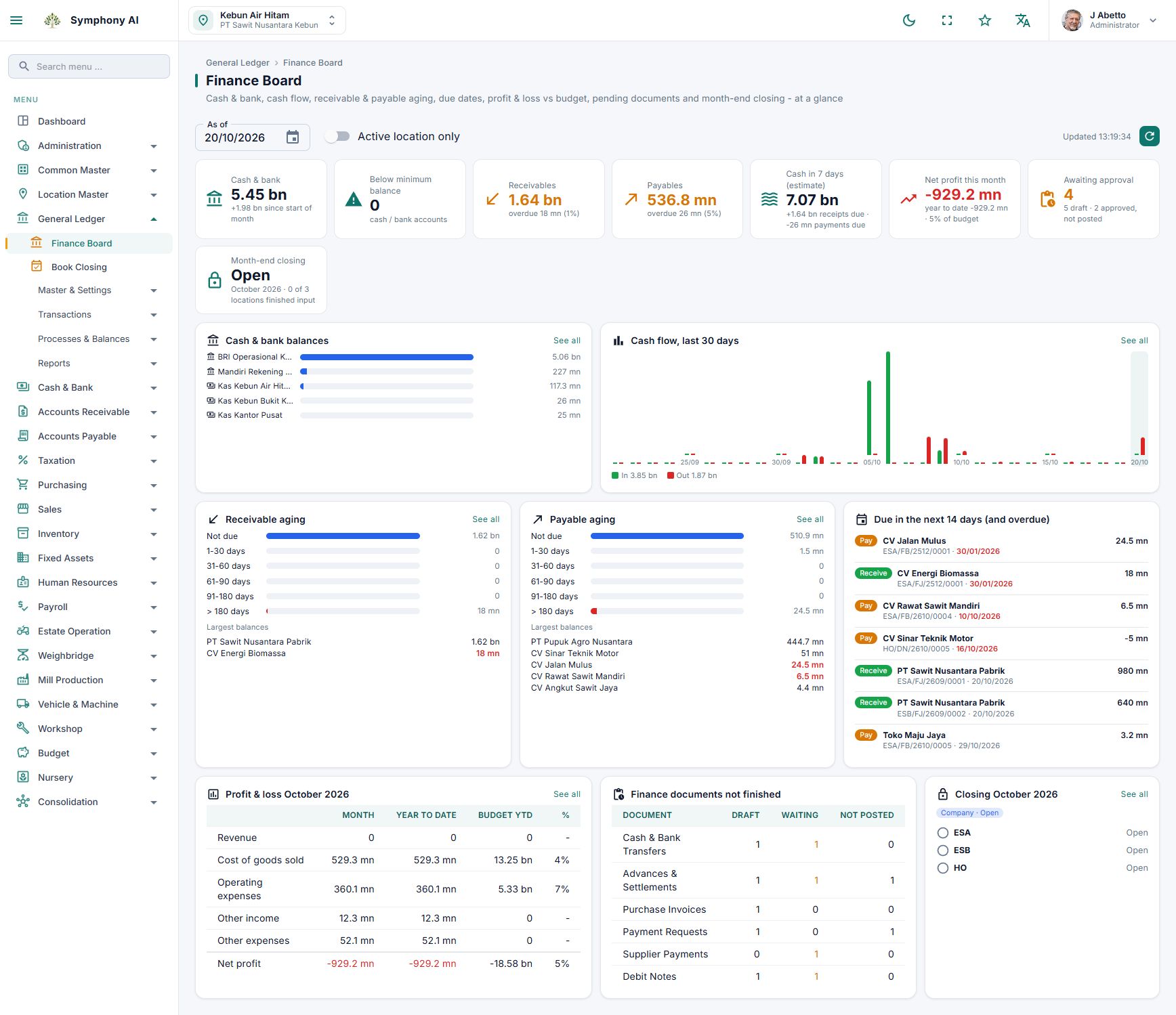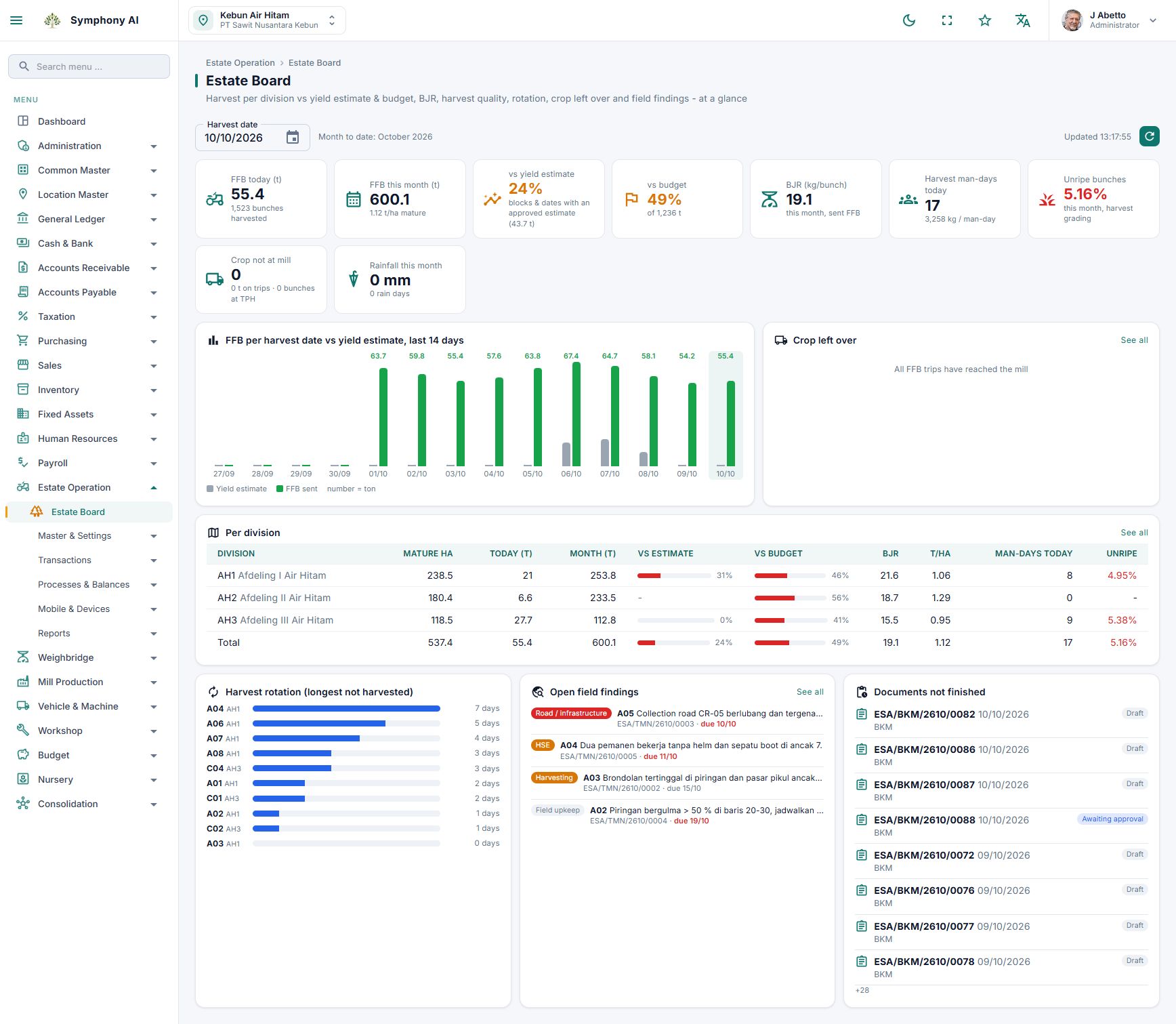
AI-Powered Plantation ERP: From Field Data to Management Decisions
Management reviews often begin with familiar figures: production, costs, budgets and overdue work. The harder questions come next. What caused the change? What needs attention first? Who owns the response? This article explores three ways to use ERP records and AI assistance to prepare decisions. All scenarios are illustrative, not customer results or demonstrations of automatically generated Symphony output.
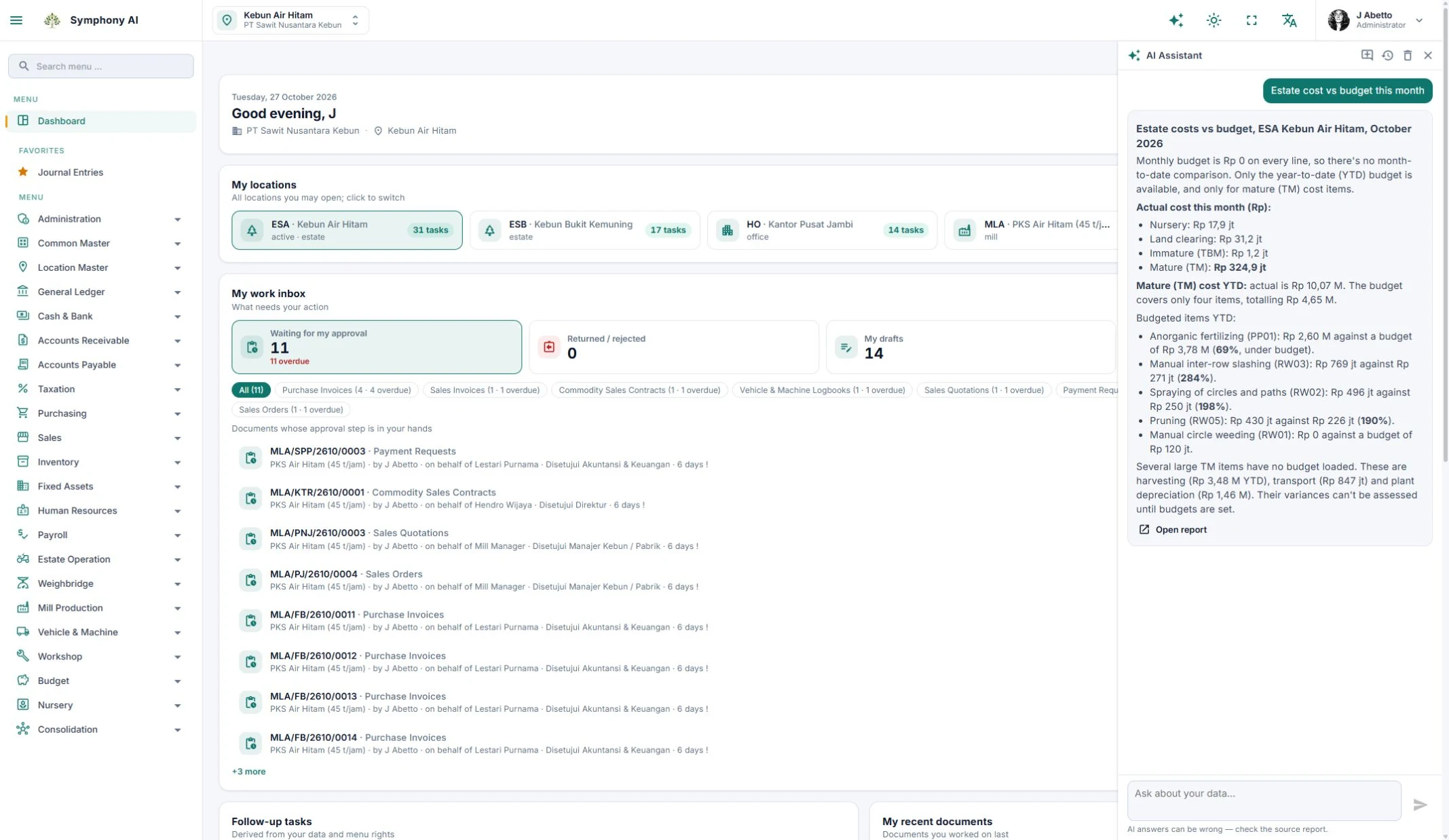
Case 1: upkeep costs increased—but is it waste?
A manager sees higher upkeep spending this month. Cutting the budget may seem reasonable, but it could be the wrong response. Costs may rise because more area was treated, material prices changed, last month's delayed work was completed, or invoices were recorded in a different period. Start by aligning the location, activity and reporting period. Separate recorded actual costs from purchase commitments. Then compare costs with work output, material usage and estate conditions. The decision is not simply why spending increased, but whether resources delivered work that was necessary.
Test the explanation before changing the work plan
For illustration, upkeep costs increase from Rp100 million for 500 hectares to Rp132 million for 600 hectares. Total cost rises 32%, while cost per hectare rises from Rp200,000 to Rp220,000, or 10%. Both figures are correct, but they describe different changes. Next, check whether activities, field conditions and quality standards are comparable. AI assistance can help explain available reports, with the explanation checked against source records. If material prices caused the difference, direct follow-up to purchasing. If usage per hectare increased without explanation, request field verification. Do not remove essential work merely to reduce the reported total.
Case 2: which purchase requests should come first?
A limited budget does not mean every request can be delayed equally. Consider a spare part for a failed pump, materials for scheduled upkeep and replacement office equipment. Their monetary values alone do not describe the impact of delay. Review usable stock, required dates, procurement lead times, existing orders and operational consequences. Use AI summaries on supported submissions to understand the initial context, then inspect supporting evidence. Management's decision is to establish defensible priorities and deadlines, rather than approving every request whose summary sounds persuasive.
Turn approval into an action that can be followed up
For a requirement that directly affects operations, agree who will confirm availability and when progress will be reviewed. Other requests may be rescheduled if the risk is acceptable. Record the reason for the decision, not just an approved or rejected status. At the next review, check whether the item arrived when needed and whether the disruption was resolved. Success is not the number of approved documents; it is fewer important activities blocked by missing resources. ERP provides cross-functional records, while the team still needs to agree ownership and follow-up responsibilities.
Case 3: cost per tonne rises while total spending stays flat
In an illustrative mill, Rp300 million divided by 3,000 tonnes equals Rp100,000 per tonne. If volume falls to 2,500 tonnes with the same cost, the result becomes Rp120,000 per tonne: a 20% increase without higher total spending. Do not immediately conclude that operators became less efficient. Investigate supply, operating hours, downtime, maintenance and the production calculation. Distinguish volume received from volume processed. Use consistent periods and units. The same principle can apply to estates and other crops, but the output unit and processing stages must reflect the operation.
Choose an action after checking the cause
If volume fell because supply arrived late, the priority may be harvest and dispatch coordination. If equipment failures recur, examine vehicle or workshop records and spare-part readiness. If costs were recorded late, improve recording timeliness before judging efficiency. AI-assisted report explanations can help frame follow-up questions, but do not establish causation by themselves. Ask the responsible teams to test the explanation using source records and operating conditions. Then define one action, an accountable owner and a date to review the result.
Move the management meeting from exceptions to decisions
An effective meeting does not need to read every report line. Select a few significant variances based on operational impact, financial exposure or deadlines. For each, present the figure and comparison basis, verified facts, remaining uncertainties, possible actions and the decision required. Use AI to help read and explain information within available features, then bring a verified summary to the meeting. Start the next meeting with the outcome of previous actions. Reports become a basis for work rather than recurring presentation material.
Evaluate Symphony with one company scenario
When evaluating Symphony Plantation AI, choose a real problem such as upkeep costs that are difficult to explain or recurring procurement delays. Ask the team to demonstrate source records, related reports, approval flow and relevant AI assistance. Check whether users can find the information needed without relying on assumptions. Agree a pilot measure: review preparation time, the number of variances explained, or actions completed on time. Suitability for oil palm, coffee, tea, rubber, sugarcane or coconut should be assessed against company processes and data, not simply the crop name.
Five questions before making a decision
- What decision is needed today?
- Are periods, units and comparison bases consistent?
- What evidence supports the proposed cause?
- What is the impact of delaying action?
- Who owns the action, and when will its result be reviewed?
How should management measure the value of AI assistance?
Start with assessable work: review preparation time, the quality of variance explanations and completion of follow-up actions. A fast AI answer is not enough if it cannot be verified or does not support a decision. Compare pilot results with the company's starting position.
Review the product screens and discuss how the workflow fits your organisation. Availability and integrations follow the agreed implementation scope.
View product details →